Here are all works listed in which we develop algorithms and/or demonstrate computational methods for large polytopes or polynomials.
References
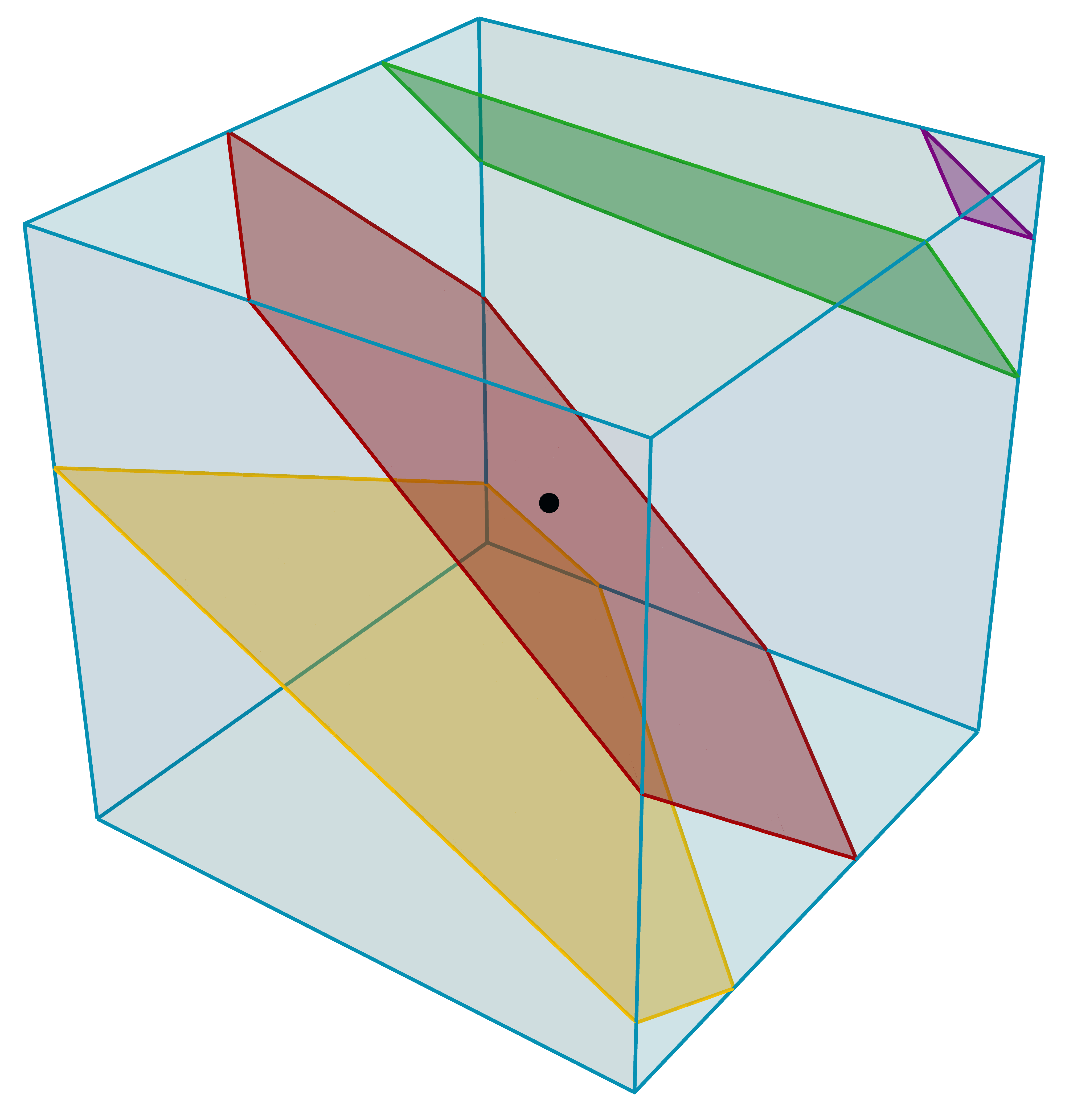
Critical moments of slices and slabs of the cube (and other polyhedral norms)
with
Jesús A. De Loera,
Yu Luo,
and Chiara Meroni.
2026.
[abstract]
[arXiv]
In this article, we present a unified algebraic-combinatorial framework for computing explicit, piecewise rational, and combinatorially indexed parametric formulas for volumes and higher moments of slices and slabs of polyhedral norm balls. Our main method builds on prior work concerning a combinatorial decomposition of the parameter space of all slices of a polytope. We extend this framework to slabs, and find a polynomial-time algorithm in fixed dimension. We also exhibit computational methods to obtain moments of arbitrary order for all slices or slabs of any polyhedral norm ball, and an algebraic framework for analyzing their critical points. In addition, we present an experimental study of the d-dimensional unit cube. Our analysis recovers and reinterprets the known volume formulas for slabs and slices of the two- and three-dimensional cubes, first obtained by König and Koldobsky. Moreover, our method identifies a new complete family of fourteen rational functions giving the volumes of slices and slabs of the four-dimensional cube. We further compute explicit higher moments of slices and slabs in dimensions two and three, and derive explicit formulas for moments of arbitrary order for slices of the two-dimensional cube, describing their critical points.
Combinatorics of slices of cubes
with
Chiara Meroni.
2025.
[abstract]
[arXiv]
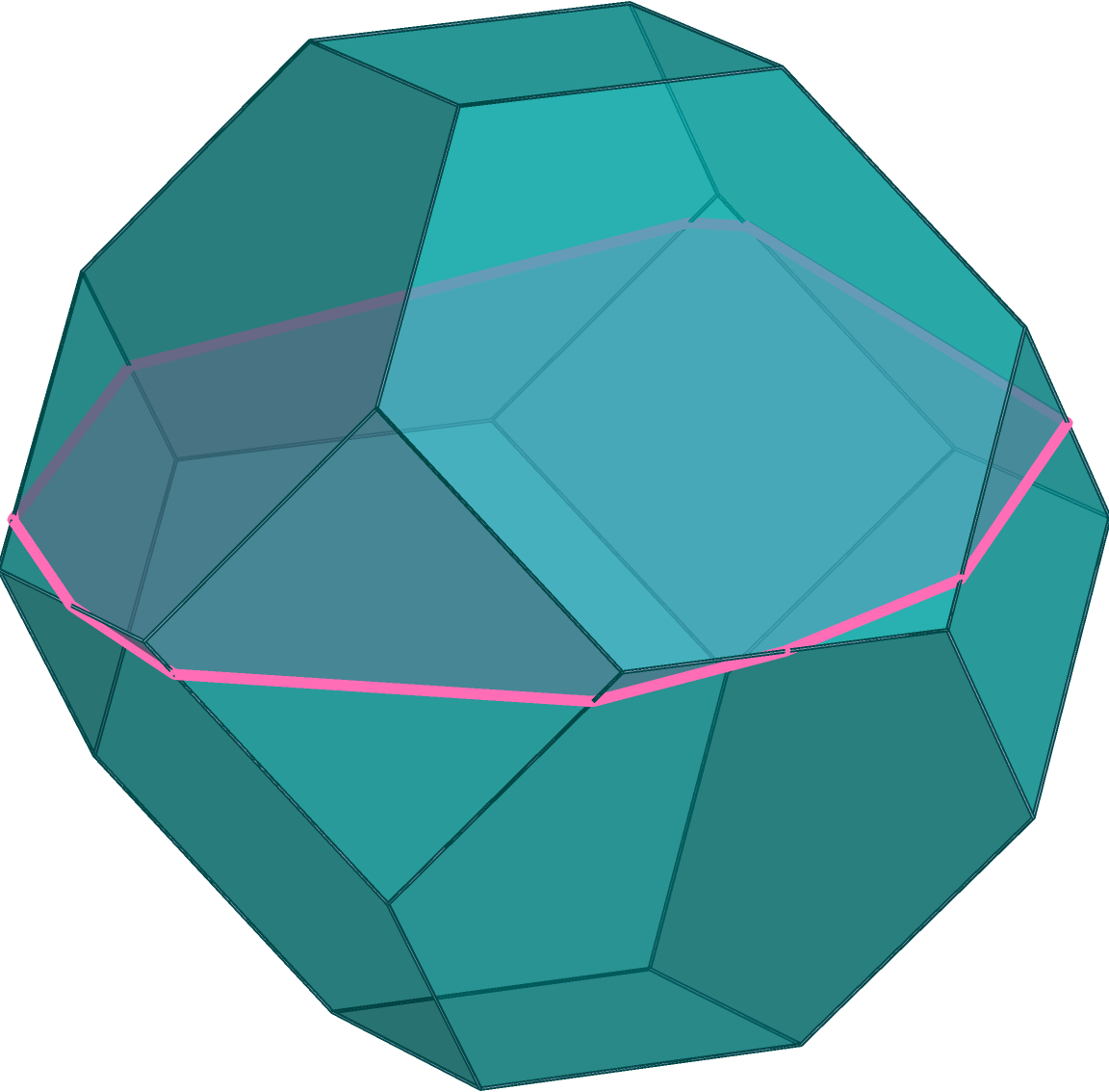
We present a complete computational classification of the combinatorial types of hyperplane sections, or slices, of the regular cube up to dimension six. For each dimension, we determine the exact number of distinct combinatorial types. When restricted to slices through the origin, our computations extend to dimension seven. The classification combines combinatorial, algebraic, and numerical techniques, with all results certified. Beyond enumeration, we analyze the distribution of types by number of vertices, establish new theoretical results about the combinatorics of slices of cubes, and propose conjectures motivated by our computational findings.
The Best Ways to Slice a Polytope
with
Jesús A. de Loera,
and Chiara Meroni.
Mathematics of Computation,
2024.
[abstract]
[doi]
[arXiv]
[supplementary material]
[bibtex]
We study the structure of the set of all possible affine hyperplane sections of a convex polytope. We present two different cell decompositions of this set, induced by hyperplane arrangements. Using our decomposition, we bound the number of possible combinatorial types of sections and craft algorithms that compute optimal sections of the polytope according to various combinatorial and metric criteria, including sections that maximize the number of \(k\)-dimensional faces, maximize the volume, and maximize the integral of a polynomial. Our optimization algorithms run in polynomial time in fixed dimension, but the same problems show hardness otherwise. Our tools can be extended to intersection with halfspaces and projections onto hyperplanes. Finally, we present several experiments illustrating our theorems and algorithms on famous polytopes.
@article{bdlm24,
  title = {The Best Ways to Slice a Polytope},
  author = {Brandenburg, Marie-Charlotte and {de Loera}, Jes\'us A. and Meroni, Chiara},
  journal = {Mathematics of Computation},
  year = {2024},
  doi = {10.1090/mcom/4006}
}
Combinatorics of Correlated Equilibria
with
Benjamin Hollering,
and Irem Portakal.
Experimental Mathematics,
April
2024.
[abstract]
[doi]
[supplementary material]
[bibtex]
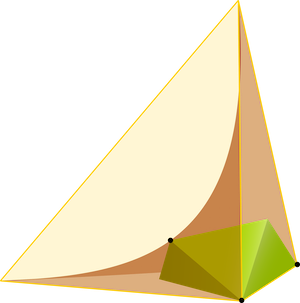
We study the correlated equilibrium polytope \(P_G\) of a game \(G\) from a combinatorial point of view. We introduce the region of full-dimensionality for this class of polytopes and prove that it is a semialgebraic set for any game. Using a stratification via oriented matroids, we propose a structured method for describing the possible combinatorial types of \(P_G\), and show that for \((2 \times n)\)-games, the algebraic boundary of the stratification is a union of coordinate hyperplanes and binomial hypersurfaces. Finally, we provide a computational proof that there exists a unique combinatorial type of maximal dimension for generic \((2 \times 3)\)-games.
@article{bhp24,
  title = {Combinatorics of Correlated Equilibria},
  author = {Brandenburg, Marie-Charlotte and Hollering, Benjamin and Portakal, Irem},
  journal = {Experimental Mathematics},
  year = {2024},
  month = apr,
  doi = {10.1080/10586458.2024.2340000}
}
Multivariate volume, Ehrhart, and \(h^*\)-polynomials of polytropes
with
Sophia Elia,
and Leon Zhang.
Journal of Symbolic Computation,
114:209-230,
January
2023.
[abstract]
[doi]
[supplementary material]
[bibtex]
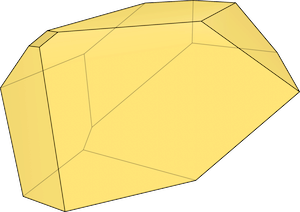
The univariate Ehrhart and \(h^*\)-polynomials of lattice polytopes have been widely studied. We describe methods from toric geometry for computing multivariate versions of volume, Ehrhart and \(h^*\)-polynomials of lattice polytropes, which are both tropically and classically convex. These algorithms are applied to all polytropes of dimensions 2,3 and 4, yielding a large class of integer polynomials. We give a complete combinatorial description of the coefficients of volume polynomials of 3-dimensional polytropes in terms of regular central subdivisions of the fundamental polytope. Finally, we provide a partial characterization of the analogous coefficients in dimension 4.
@article{bez23,
  title = {Multivariate volume, Ehrhart, and \(h^*\)-polynomials of polytropes},
  author = {Brandenburg, Marie-Charlotte and Elia, Sophia and Zhang, Leon},
  journal = {Journal of Symbolic Computation},
  volume = {114},
  pages = {209-230},
  year = {2023},
  month = jan,
  issn = {0747-7171},
  doi = {10.1016/j.jsc.2022.04.011}
}